By Dana Byers, certified life and leadership coach | Last updated: October 2026
Christian self-care without guilt begins with receiving: letting God and the people around you meet needs you have been quietly carrying alone. For many capable Christian women, rest is not the hardest part of self-care. Accepting a meal, a favor, or an offer of help is.
If that's you, you're in good company. Years ago, I realized I was the woman who needed extra support, and I have no shame in that whatsoever. Learning to receive took me almost as as learning to rest.
Women who only give tend to run dry. Scripture shows Jesus receiving care openly, and research suggests the people around you are far more willing to help than you expect. One 2008 study found people underestimated how often others would agree to a direct request for help by as much as 50%.
This guide covers what guilt-free Christian self-care looks like, why receiving is biblical, where each of the six Kind Birdie Soul Care types tends to get stuck, and three small practices you can start this week. It is adapted from the first teaching in The Upward Year, our twelve-month soul care experience, because receiving is where every woman's year begins.
In this article
- What Christian self-care without guilt means
- Why receiving care is biblical
- Why capable women feel guilty receiving help
- Where each Soul Care type gets stuck
- The night a meal became ministry
- Three ways to practice receiving this week
- Christian self-care resources for overwhelmed women
- FAQs about Christian self-care
What Christian Self-Care Without Guilt Means
Christian self-care without guilt is caring for your body, mind, and soul as a steward of what God entrusted to you, without treating your own needs as selfish. It includes rest and quiet time with God, and it also includes something many women skip: letting others care for you.
Self-care as stewardship
Your energy, health, and attention are gifts to steward, the same as your time and money. Tending them is part of faithfulness. A depleted woman cannot love her family, serve her church, or lead at work the way she wants to.
Where the guilt comes from
Guilt often attaches itself to receiving. Consider this: working harder or picking up a treat for yourself may not lead to feeling guilty. However, many women have a hard time letting a friend take responsibility for something they feel they should do instead. Christian self-care without guilt names that pattern so you can practice something different.
If burnout has already set in, writing your way back to God through burnout is a gentle place to start untangling it.
Why Receiving Care Is Biblical
Receiving care is biblical because Jesus received it fully and without apology, and the early church was built on believers caring for and supporting one another.
What Jesus modeled
In Luke 7, a woman washed his feet with her tears and dried them with her hair, and Jesus defended her in front of a disapproving host (Luke 7:36-50). He accepted hospitality at the home of Martha and Mary. In John 12, Mary of Bethany anointed his feet with expensive perfume, and when others objected, Jesus told them to leave her alone (John 12:1-8).
He did not minimize any of it or rush to repay it.
Because the Son of God let himself be cared for, it's worth asking ourselves why we believe we shouldn't be.
Carrying one another
Galatians 6:2 tells believers to carry each other's burdens. That instruction assumes some of us will be the ones who need carrying. When you refuse help every time, you miss some of the blessings God sends through other people, and you keep others from the joy of giving.
Why Capable Women Feel Guilty Receiving Help
Capable women often feel guilty receiving help because they learned early that needing things was inconvenient, and because they misjudge how others feel about helping.
The habit of competence
Maybe you are the one who brings the meals, remembers the birthdays, and stays late without making a fuss. Giving feels natural, maybe even holy. Over time, competence gets praised and need gets quietly ignored, so accepting help starts to feel like admitting failure.
What researchers found
Psychologists Xuan Zhao and Nicholas Epley studied 2,118 adults in the United States across scenarios, recalled experiences, and live interactions. Their 2022 paper in Psychological Science found that people needing help underestimated others' willingness to help, underestimated how good helpers would feel, and overestimated how inconvenienced helpers would be.
An earlier study by Francis Flynn and Vanessa Bohns (published as Lake) in the Journal of Personality and Social Psychology found that people underestimated by as much as 50% how likely others were to say yes.
In other words: the friend offering to help is probably glad to be asked.
Where Each Soul Care Type Gets Stuck
Each of the six Kind Birdie Soul Care types resists receiving in its own way, so guilt-free self-care starts in a different place for each one.
| Soul Care type | Where receiving gets blocked | A first step toward receiving |
|---|---|---|
| Overly Attentive Caretaker | Gives constantly, then wonders why she feels so depleted | Let someone take one task off your list this week, and resist redoing it |
| Guilt-Ridden Giver | Says yes out of obligation and feels shame when she considers her own needs | Accept one offer of help without apologizing or explaining |
| Invisible Impact-Maker | Does quiet, faithful work no one seems to notice, so care feels unearned | Tell one trusted friend what you have been carrying |
| Wounded Achiever | Built a wall around her needs early, because needing too much once felt unsafe | Say one need out loud to someone who has earned your trust |
| Restless Executive | Treats rest and receptivity as inefficiencies to eliminate | Put one restoring hour on your calendar and keep it like a meeting |
| Creative Juggler | So busy generating ideas that she rarely pauses long enough to take anything in | Before starting the next project, ask what would refill you first |
All six share a famine of input. The depletion comes from giving without letting anything back in.
For a closer look at your pattern, read about restoring margin as an Overly Attentive Caretaker, healing and restoration for the Wounded Achiever, or a sacred creative rhythm for the Creative Juggler. Not sure which type fits? Take the free Soul Care Quiz to find out in about two minutes.
The Night a Meal Became Ministry
The most important lesson I have learned about receiving came three days before my son's first birthday, when he nearly died and needed life-saving surgery.
The night we came home from the hospital, we had been prepared for difficult months ahead. He'd survived surgery, but there were more unknowns than knowns at that point. A friend I had only recently met in a church small group showed up at our door with a warm meal in her hands. She hadn't called first. If she had, I would have told her we were fine.
But we were not fine. That meal became one of the most ministering moments of my life, and I still think about how close I came to waving it away. God's provision came through a friend who was brave enough to knock without asking permission.
Receiving rarely announces itself as a gift you are allowed to accept. It arrives uninvited, in the middle of the moment you were sure you had to carry alone, and it asks you to let someone else hold a piece of it with you.
Three Ways to Practice Receiving This Week
Receiving is a skill you can practice in small, concrete ways, and these three exercises start retraining the reflex to wave help away.
1. Name your needs honestly
Every weekday page of the Upward Planner includes an N prompt, Name Your Needs. Don't skim it this week. Write down what you actually need, spiritually, emotionally, physically, or mentally, rather than what you can manage without.
2. Block one window for restoration
Look at your week and find one window of time that belongs to your restoration. Rest, beauty, or nourishment all count. Write it in and keep it with the same commitment you give every other appointment.
3. List three people you could ask
This prompt from page 85 of the Aligned Journal is a good place to begin: Where in your life do you need more support right now? List 3 people or services you could ask for help.
Coaching questions to sit with
- When did you first learn that needing things was inconvenient or unsafe? How has that belief shaped the way you give and receive today?
- If a woman you love came to you with the same needs you are denying yourself, how would you respond to her?
- What is one specific act of receiving you could practice this week, and what would you have to let go of to make room for it?
Christian Self-Care Resources for Overwhelmed Women
Christian self-care gets easier with a simple rhythm to return to, and Kind Birdie offers free and paid tools built by a certified coach for exactly that.
Free places to start
- 10 Holistic Rest Practices for Overwhelmed Women, a free guide to the types of rest you may be missing
- Rest for the Weary, a free seven-day email devotional
- The Soul Care Quiz, to find your type and your next step
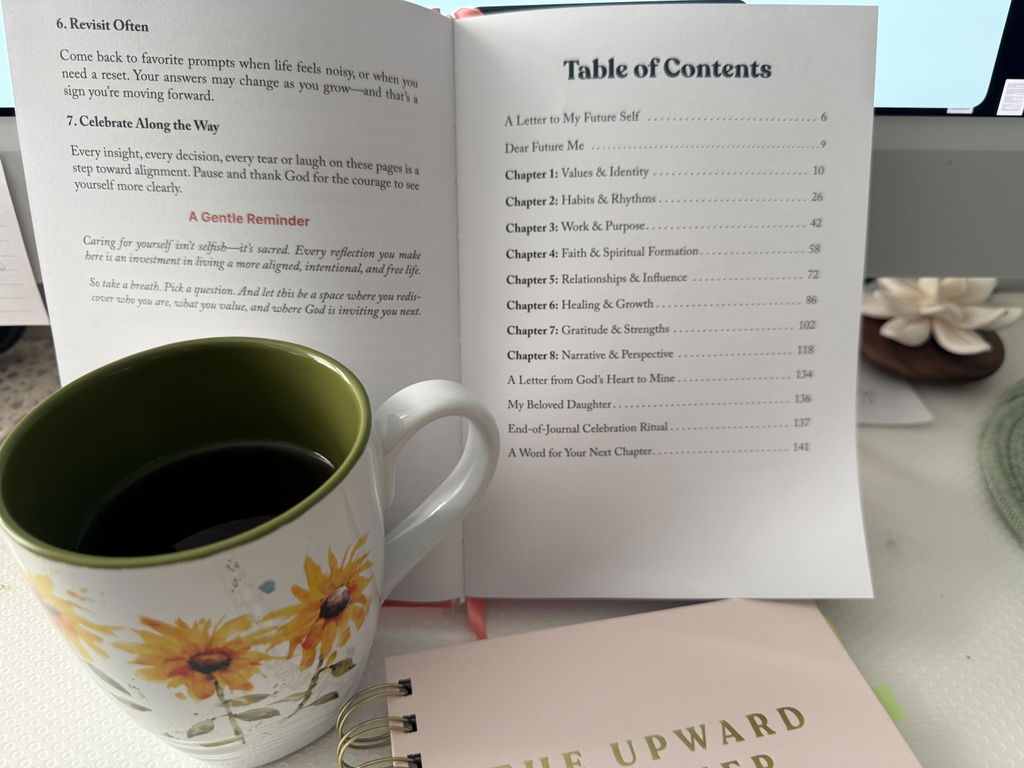
The Upward Year
This article comes from Month 1 of The Upward Year. It pairs four Upward Planners, shipped together in the colors you choose, with a monthly soul care teaching that includes Scripture, a planner practice, and coaching questions. A bonus teaching arrives mid-year, when the middle gets hard, and when you reply to a teaching I write back personally.
Later teachings include Rest Is Not a Reward, No Is a Complete Sentence, The Practice of Enough, and more. The Upward Year is $129, one payment, and nothing renews. Your first teaching arrives the day you join.
You can also browse all Kind Birdie Christian planners, journals, and gifts.
FAQs About Christian Self-Care
Q: Is self-care biblical for Christian women?
A: Yes. Scripture treats the body and life as gifts to steward, and Jesus withdrew to rest and pray and received care from others. Christian self-care is faithful stewardship of what God entrusted to you, so you can keep loving and serving from a full place rather than an empty one.
Q: Why do I feel guilty when someone helps me?
A: Guilt often comes from an early belief that needing things makes you a burden. Research by Zhao and Epley (2022) found people consistently underestimate how willing and happy others are to help. The guilt is real, but it is usually based on a wrong guess about how the helper feels.
Q: How do I practice self-care without feeling selfish?
A: Start small and specific. Name one real need, then accept one offer of help this week without apologizing or explaining. Notice the guilt without obeying it. Practicing in low-stakes moments makes it easier to receive care when you need it most.
Q: What is soul care?
A: Soul care is tending your inner life with God: rest, prayer, Scripture, honest reflection, and receiving support from others. Where general self-care focuses on the body and mood, soul care asks how you are doing with God and what your soul needs to stay anchored.
Q: What does the Bible say about asking for help?
A: Galatians 6:2 tells believers to carry one another's burdens, which assumes some will need carrying. Jesus accepted hospitality, meals, tears, and anointing without deflecting them. Asking for help lets the body of Christ work the way God designed it.
Q: What are the six Kind Birdie Soul Care types?
A: The six types are the Overly Attentive Caretaker, Guilt-Ridden Giver, Invisible Impact-Maker, Wounded Achiever, Restless Executive, and Creative Juggler. Each describes a common pattern in how capable Christian women give, rest, and receive. The free Soul Care Quiz shows which one fits you.
Q: What is The Upward Year?
A: The Upward Year is a twelve-month soul care experience from Kind Birdie. It includes four 90-day Upward Planners shipped at once and thirteen teaching emails with Scripture, planner practices, and coaching questions. It is $129, one payment, nothing renews, and you can start any day.
Start With One Small Act of Receiving
Christian self-care without guilt starts with letting care in. The people around you want to help more than you think, and Jesus showed that accepting care takes nothing away from a faithful life.
This week, pick one practice above and let one person help you with one thing. Then notice how it felt. That's it.
May you receive what God sends your way this week, Birdie, without apologizing for needing it.
If this teaching met you where you are, there are twelve more waiting in The Upward Year, and your first one arrives the day you join.