Cultivating Discernment Through Contemplative Practices
You know the feeling. You wake up ready. Clear headed, hopeful, maybe even a little energized. And then somewhere around 3pm, choosing what to make for dinner feels like it requires the same strength as a board decision did that morning.
If you're leading a ministry, a household, a team, a family, or all of the above, you are making hundreds of small choices before lunch most days. And every single one of them is quietly spending something. There's a name for this. It's called decision fatigue, and it's one of the most common, least talked about struggles among Christian women in leadership. If you've felt it, you are not weak, and you are not doing it wrong. You are simply human, carrying a very full life.
We want to talk about what's actually happening when your mind starts to feel foggy by evening, what Scripture has already said about decision fatigue long before anyone coined a clinical term for it, and some gentle, doable ways Christian women leaders can protect their peace, their clarity, and their spiritual growth in the middle of it all.
Your Mind Was Never Meant to Hold It All
Here's something worth sitting with. Your brain has a limit. Not because something is wrong with you, but because that's how you were made. Every choice you make throughout the day draws from the same well, whether it's a decision about your business, what to wear, or which email actually needs a response today. None of it is free. It all costs something.
This is why the sharpest, most capable women you know can still find themselves short tempered by 6pm, or putting off a decision they'd normally make in seconds, or making a choice at 9pm they wouldn't have made at 9am. It isn't a character flaw. It's depletion. And depletion always asks for rest, not shame.
Some signs worth noticing in yourself: snapping more easily than usual, avoiding decisions altogether, putting off things that matter, or making choices that don't quite line up with who you actually are. Noticing these things isn't self criticism. It's the first gentle step toward getting your peace back.
God Already Knew This About You: Faith and Leadership Were Never Meant to Be at Odds
Long before neuroscience gave this a name, Scripture had already made room for it. This is really where faith and leadership meet. God never asked you to lead from an empty well.
Think of Elijah under the broom tree. A prophet who had just witnessed God move powerfully, completely spent, asking God to let him die. And what did God offer him? Not a pep talk. Not a new assignment. Sleep. Food. Rest. Then, quietly, His presence. Elijah's restoration didn't come through more effort. It came through tending to his body first, and his soul second.
Proverbs 3:5-6 tells us to trust the Lord with all our heart and lean not on our own understanding. That verse isn't just a nice sentiment for a journal page. It's permission. Permission to stop white knuckling every decision on your own strength, and to hand the weight of it to Someone who was never meant to be an afterthought in your day.
Surrendering your decisions to God doesn't make them disappear. But it does change what they cost you. A choice made in dependence feels different than a choice made in anxious striving. One is stewardship. The other is exhausting.
Prayer, in this context, isn't a ritual you check off. It's an invitation. Not asking God to weigh in on every small thing, but staying close enough to Him that discernment starts to feel less like a solo effort and more like walking alongside Someone who already knows the way.
Small, Gentle Shifts That Help Christian Women Leaders Overcome Decision Fatigue
Instead of finding a whole new system to adjust to, make a few honest adjustments that give your mind some room to breathe, and that support the kind of steady, God-led Christian leadership you actually want to practice.
Let your mornings do some of the deciding for you. A simple, steady morning rhythm removes dozens of tiny decisions before your day even really starts. This isn't about rigidity. It's about freedom. When your wake time, your quiet time, your breakfast, and your movement are already decided, your mind is free for what actually matters that day. A planner built around Scripture and gentle structure can carry some of that weight for you, so you're not rebuilding your framework from nothing every single morning.
Decide once instead of a hundred times. This is the quiet power of pre-commitment. Set your standards for what gets a yes on your calendar, when you'll respond to messages, what your budget allows, ahead of time, so you're not relitigating it every time a request comes in. Deciding your process in advance is its own form of stewardship. You're protecting the mental capacity God gave you, not hoarding it.
Group like decisions together. Pick one evening to plan your outfits for the week. Set specific windows for email instead of reacting all day long. Do the same for meal planning, content approval, or anything else that repeats. Every time you switch between types of decisions, it costs you a little more energy. Batching protects that energy instead of draining it in pieces.
Choose tools that hold space for your soul, not just your schedule. A planner that only manages your to-do list is missing half the point. Look for one that also makes room for Scripture, for honest reflection, for gratitude, and for a structure simple enough that it lightens your load instead of adding to it. When a tool feels like a sacred pause in your day rather than one more obligation, you'll actually want to open it.
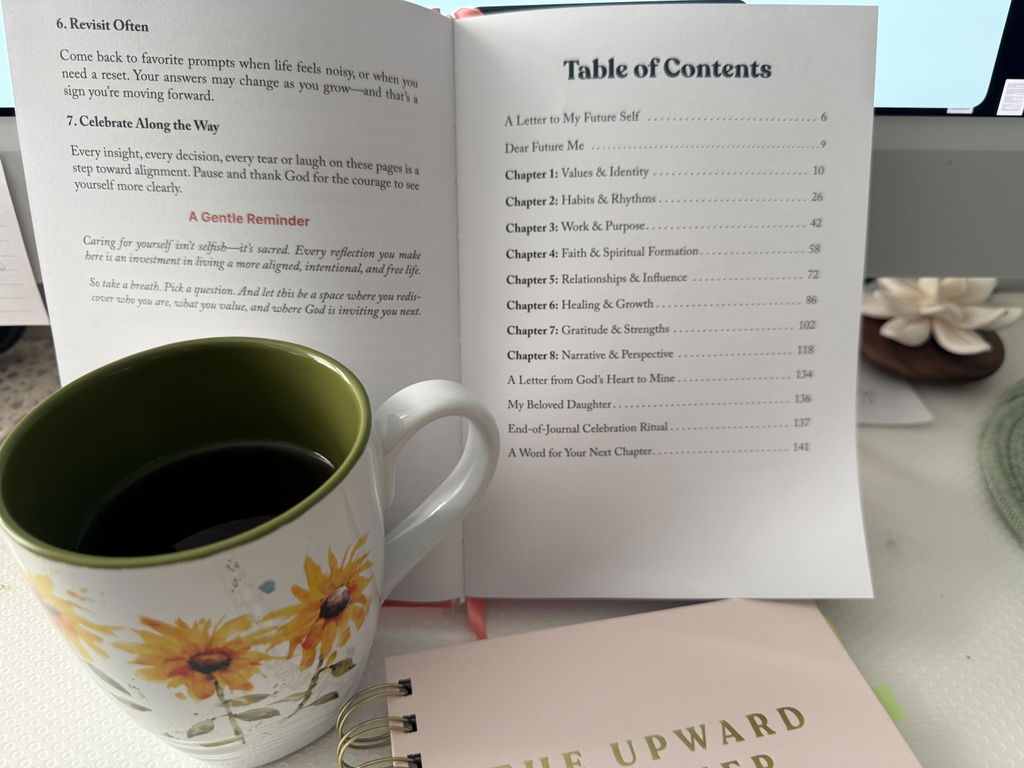
This is exactly why we built the Upward Planner. It's not another system to manage. It's a quiet place to bring your priorities, your Scripture reflection, and your real life, so your mind doesn't have to hold it all alone. If decision fatigue has been creeping into your leadership, it may be worth giving yourself a tool that carries some of that weight with you. Explore the Upward Planner here.
Let go of what isn't yours to hold. So many of us confuse serving well with deciding everything ourselves. But even Moses needed Jethro to tell him he couldn't carry it all alone, and that letting go wasn't a failure of leadership, it was wisdom. Delegating isn't about being less involved. It's about multiplying what God has entrusted to you, and trusting the people around you enough to let them carry some of it too.
A simple way to think it through: hold onto the decisions that require your unique wisdom, your calling, or your heart for the people you lead. Release the ones that are routine, or that someone else could grow into handling well. Letting go of the second kind isn't neglect. It's often exactly what helps your team, your family, or your ministry grow.
Sabbath Isn't a Suggestion
Rest is not the reward you earn after everything is done. It's part of how God designed you to function in the first place.
A true Sabbath isn't just an empty square on the calendar. It's a real, honest stepping away from the constant pressure to weigh in, to choose, to respond. It might mean putting the phone down. It might mean letting an "urgent" request wait until Monday. It might mean quietly setting aside the belief that everything falls apart without you.
That belief, if we're honest, often comes from pride more than responsibility. And a real day of rest, tech-free and unhurried, changes what Monday feels like. Your discernment on Monday is only as clear as the rest you allowed yourself on Sunday.
Your Body Is Part of This Story Too
Faith and biology were never meant to compete with each other. They work together.
Sleep, food, and movement all shape how clearly you're able to think and choose. When you consistently trade rest for one more task, you're not actually gaining ground, you're quietly borrowing against tomorrow's clarity. What you eat matters too. Steady, nourishing meals support steady, nourishing decisions. And movement, even something as simple as a short walk, has a way of clearing the fog and giving your mind room to reset.
Taking care of your body isn't vanity. It's stewardship of the very vessel God is using to lead through you.
Let Contemplative Practice Do the Slow Work of Spiritual Growth
Practices like lectio divina, the examen, or simply sitting in quiet prayer aren't extra tasks for an already full life. They're a different way of engaging with God that trains your heart, over time, to recognize His voice more easily. This is spiritual growth in its quietest, most sustainable form.
Instead of scrambling for direction in the middle of every decision, you begin to carry a steadier awareness of His presence that quietly shapes your choices without you having to force it.
Journaling fits here too. Something happens when you put the noise in your head onto paper. It creates just enough distance to see clearly. And over weeks and months, your own words start to show you patterns, your energy, your triggers, the seasons when you need to slow down before you're forced to.
You Were Never Meant to Carry This Alone
Isolation makes decision fatigue heavier than it needs to be. You were never designed to hold the full weight by yourself, and Scripture's picture of community has always been about shared burdens, not solo endurance.
Find a small circle who understands your season and shares your faith. People you can be honest with, who will pray with you and help you see what you can't see from inside your own exhaustion. And don't underestimate mentorship, in either direction. Learning from someone further down the road saves you from some of the hardest lessons. Mentoring someone else has a way of clarifying your own thinking too.
When It's More Than Tiredness
Sometimes what feels like decision fatigue is actually something deeper. If you're finding it nearly impossible to make even small choices, if your mood has shifted in ways that concern you, if you're carrying physical symptoms like frequent headaches, or if you keep making choices that don't feel like you, that may be more than a full season. It may be worth talking to a doctor or a counselor.
Faith and professional care were never meant to be at odds. God works through wise counsel and medical care just as truly as He works through prayer. Asking for help is not a lack of faith. It's wisdom.
And if things ever feel truly heavy, hopeless, or unsafe, please reach out to a healthcare provider right away. You don't have to carry that alone either.
Grace Was Always Part of the Plan
Perfectionism has a way of making every decision feel like it carries eternal weight. When nothing is allowed to be simply good enough, everything becomes exhausting.
Grace-filled leadership means accepting that you'll make imperfect choices with whatever information and capacity you have in that moment. That's not an excuse to be careless. It's freedom from the impossible standard of never getting it wrong.
Scripture is full of imperfect people God used anyway. Your worth was never tied to flawless judgment. It was always tied to your willingness to show up faithfully, limitations and all.
Let some decisions be small. Save your deepest discernment for what truly matters. That, too, is wisdom.
You carry a lot. That was never a secret to God, and it doesn't need to be a secret weight you carry alone either. Decision fatigue isn't a flaw to hide. It's simply a sign that you're human, doing meaningful work, in need of the same rest and rhythm God has always offered every Christian woman leader who came before you.
Light hearts. Anchored souls. That's the invitation, one small, faithful decision at a time.